
10 small daily moves for a better mood
When your mood is low, big changes feel impossible. The good news is that you don't need them. Small moves in everyday life can have a big impact on our overall wellbeing, especially when they become habits.
None of the following takes more than 5 minutes. You don't need to do them all. Pick one or two that suit you and try them for a week.
1. The first 10 minutes without your phone
Don't reach for your phone as soon as you wake up. Messages, news and social media set the mind replying to others from the very first minute. Give the first minutes of the day to yourself: a glass of water, a few breaths, a look out of the window.
Why it works: you start the day with a sense of control, not with reaction.
2. Morning light
Step out onto the balcony for a few minutes or take a short walk, ideally within the first hour after waking.
Why it works: natural light in the morning helps our body clock, which affects energy, mood and sleep at night.
3. Five minutes of mindful breathing
Breathe in through your nose, then take a second small breath on top of the first, and breathe out very slowly through your mouth. Repeat for 5 minutes.
Why it works: in a 2023 study, people who did this exercise for 5 minutes a day for a month saw a greater improvement in mood than those who did mindfulness meditation for the same amount of time. A slow out-breath calms the nervous system.
4. Five minutes of walking
Around the block, on the stairs, even inside the house.
Why it works: movement is one of the best-supported tools for mood and anxiety, and the effect starts from the very first time.
5. One thing to look forward to
In the morning, write down one small thing that will make you happy today: a coffee with someone, an episode, a bath.
Why it works: with depression and stress we lose pleasant activities. When we plan them on purpose, the mood follows. This idea is the basis of "behavioural activation", one of the most effective techniques in psychotherapy.
6. Three things that went well
In the evening, write down three things that went well today, however small.
Why it works: in a classic study, people who regularly wrote down things they felt grateful for were more optimistic and felt better about their lives. We teach the mind to notice the good too, not just the problems.
7. One message to one person
Send a message to someone you thought of: "I thought of you today."
Why it works: connection with others is one of the strongest protective factors for mental health. And it usually does both of you good.
8. One song, your whole body
Put on a song you love and move. Dance, stretch, walk to the rhythm.
Why it works: it combines movement, pleasure and a change of state in 3–4 minutes.
9. Tidy just one surface
Not the whole house. Just the bedside table, or just the desk.
Why it works: a small, finished task gives a sense of control and success, especially on days when everything feels heavy.
10. Screen-free zones
Choose a place (e.g. the dining table or the bed) or a time (e.g. the last hour before sleep) with no phone and no social media.
Why it works: less comparison with others, less overstimulation, better sleep.
My own morning routine
If you're wondering what this looks like in practice, here is mine:
- In the morning, as soon as I wake up, I get ready for my morning movement outside: 5 kilometres, in the morning light, without looking at my phone.
- Outside, I do my meditation and set my goal for the day.
- When I get back, I make my coffee and plan the most important things I have to do today.
You don't need to start with 5 kilometres. Five minutes outside, without your phone, is already a start.
How to make them a habit
- Link it to something you already do. "After I make coffee, I step out on the balcony for 3 minutes."
- One at a time. Once one becomes automatic, add the next.
- No guilt if you miss a day. Tomorrow is a new chance.
If you'd like to keep track, the free Daily Reflection journal in Digital Tools has space for your morning priorities and for "what went 1% better" each evening (in Greek).
When small moves aren't enough
These moves help, but they don't replace help when it's needed. If your mood has been low for more than two weeks, if you find it hard to function, or if you have thoughts of harming yourself, talk to a professional. In an emergency in Greece, call the Suicide Prevention Line 1018 or 112.
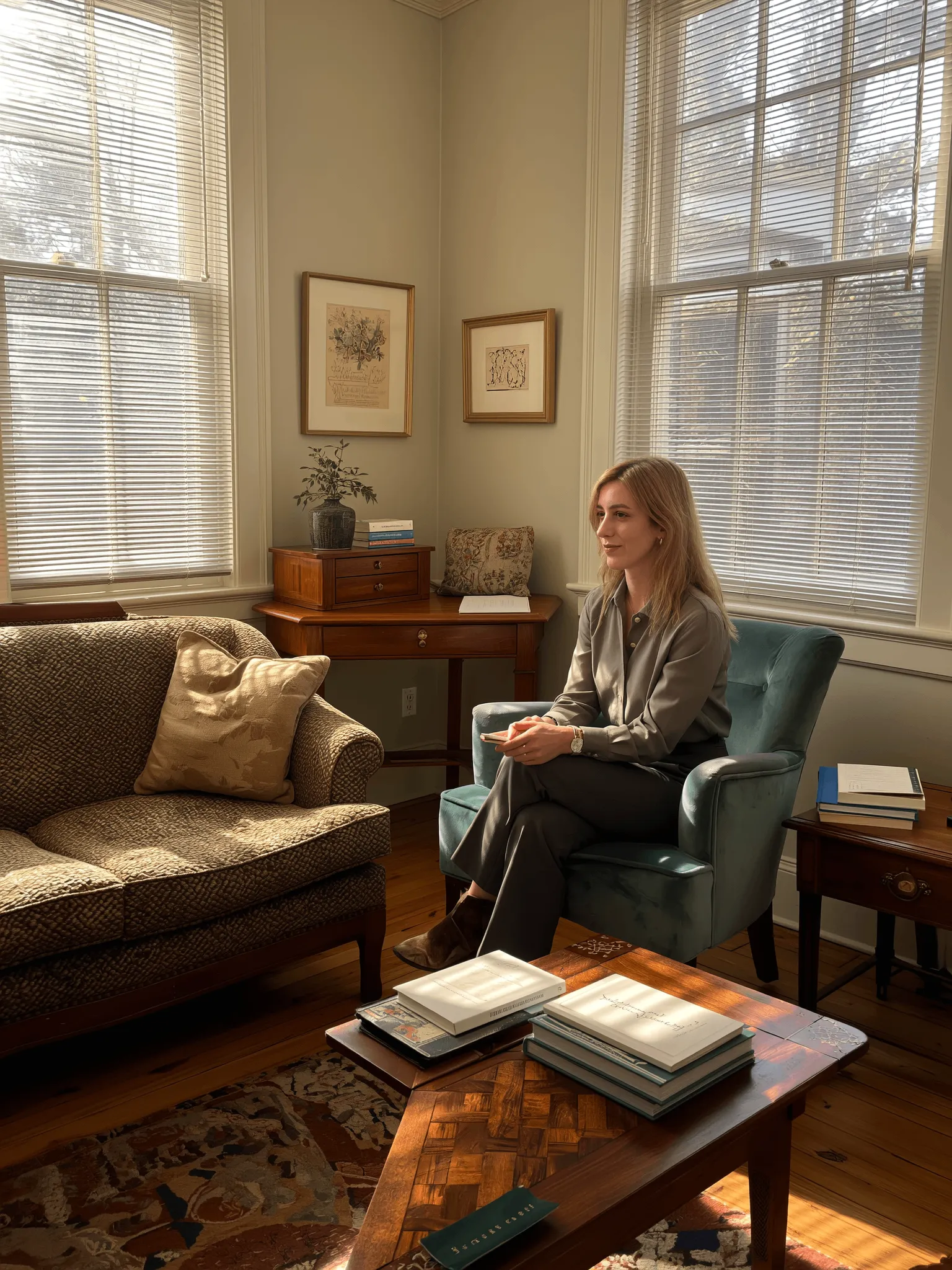
Written by
Aristea Kontokosta, Psychologist
BSc in Psychology (University of Ioannina) and Adult Educator certification (University of Macedonia), with training in Cognitive Behavioural Therapy and NLP. She works with anxiety, depression, habits and holistic wellness, online and in person in Kallithea, Athens.
Sources
- Balban, M. Y., Neri, E., Kogon, M. M., et al. (2023). Brief structured respiration practices enhance mood and reduce physiological arousal. Cell Reports Medicine, 4(1), 100895.
- Emmons, R. A., & McCullough, M. E. (2003). Counting blessings versus burdens: An experimental investigation of gratitude and subjective well-being in daily life. Journal of Personality and Social Psychology, 84(2), 377–389.
- Cuijpers, P., van Straten, A., & Warmerdam, L. (2007). Behavioral activation treatments of depression: A meta-analysis. Clinical Psychology Review, 27(3), 318–326.
- Singh, B., Olds, T., Curtis, R., et al. (2023). Effectiveness of physical activity interventions for improving depression, anxiety and distress: An overview of systematic reviews. British Journal of Sports Medicine, 57(18), 1203–1209.
- Santini, Z. I., Jose, P. E., Cornwell, E. Y., et al. (2020). Social disconnectedness, perceived isolation, and symptoms of depression and anxiety among older Americans (NSHAP): A longitudinal mediation analysis. The Lancet Public Health, 5(1), e62–e70.